
By Brittany McLendon, Senior Content Writer
April 2026
After school. Evenings. Weekends.
Your facilities are constantly in use.
Schedules change. Spaces get shared. Requests come in from different directions.
But when someone asks:
- Who approved this?
- Who was in the building?
- Who’s responsible if something goes wrong?
The answers aren’t always clear.
And when that information lives across emails, calendars, and spreadsheets – without a centralized facility scheduling software for schools – what should be a simple answer becomes a real risk.
The Hidden Risk of Community and External Group Facility Use
Schools are regularly asked to open their facilities to outside groups—youth leagues, community organizations, churches, and local programs.
Most schools want to say yes.
The challenge isn’t the groups themselves—it’s the lack of a consistent process behind approving and managing their use caused by not having a dedicated facility scheduling software system.
When an external group uses your facilities, the questions go beyond scheduling:
- Has the group provided proof of insurance?
- Is there a signed facility use agreement on file?
- Was the request formally approved, or handled informally?
- Is there a staff member responsible for oversight during the event?
Without a clear process, these details get missed — not because no one cares, but because there’s no facility scheduling system requiring them upfront.
And when something goes wrong, it’s no longer a scheduling issue.
It’s a liability question—one that’s difficult to answer without documentation.
External groups don’t just use your space.
They use your:
- Equipment
- Utilities
- Custodial resources
Gym floors wear down faster. Cleaning crews have to return. HVAC runs longer than expected.
And without a clear record of who used what—and when—there’s no way to track those costs, recover them, or even prove they exist.
Managing community use of school facilities requires more than a shared calendar.
It requires a process that captures approvals, documentation, and accountability—before the group ever walks through the door.
The Visibility Gaps Inside Your Own Building
The same visibility issues don’t just apply to external groups.
They exist inside your building as well.
And because internal use feels familiar, these gaps are often harder to catch—and easier to overlook.
Without a centralized facility scheduling software for schools, things are not tracked clearly—regardless of who’s doing the using —and small oversights become real problems:
- Double-booked spaces that disrupt practices, games, or events
- Unapproved after-hours use with no record of who authorized it
- Staff arriving unprepared, with no setup, coverage, or supervision arranged
- Equipment or facility damage with no clear record of who was responsible
- Utilities and supplies used without any oversight or tracking (toilet
- Decisions made informally, with no documentation of who approved what
Most of the time, these are operational headaches. But they don’t stay that way.
In an emergency, these gaps become something more serious.
A calendar might tell you a group was scheduled to be there.
It doesn’t tell you:
- Who is actually in the building
- How many people are there
- Where they are located
- How to reach them
And in situations like a lockdown, evacuation, or safety incident—that information matters immediately.
That’s when a visibility gap stops being an operational inconvenience and becomes the reason you can’t account for everyone in your building.
Why Facility Scheduling Breaks Across Systems
Most schools manage facility use across multiple systems — athletic schedules, shared calendars, spreadsheets, email requests. Each one serves a purpose. But none of them show everything together.
That’s where the problem starts.
That’s how gaps appear:
- A schedule is updated in one system—but not reflected anywhere else
- Requests are approved informally—with no record of who approved them
- Facility use happens without ever being fully documented
Individually, these don’t seem like major issues. But over time, they create a system where no one has a complete view of what’s actually happening.
And when something needs to be confirmed—
who approved a request, who was in the building, what actually happened—
there’s no single place to look.
At that point, the issue isn’t how facility use is being managed. It’s that there isn’t a system designed to manage it.
What most schools run into isn’t a scheduling problem. It’s a system problem. This is exactly the problem K-12 facility scheduling software is designed to solve.
What K-12 Facility Use Tracking Actually Requires
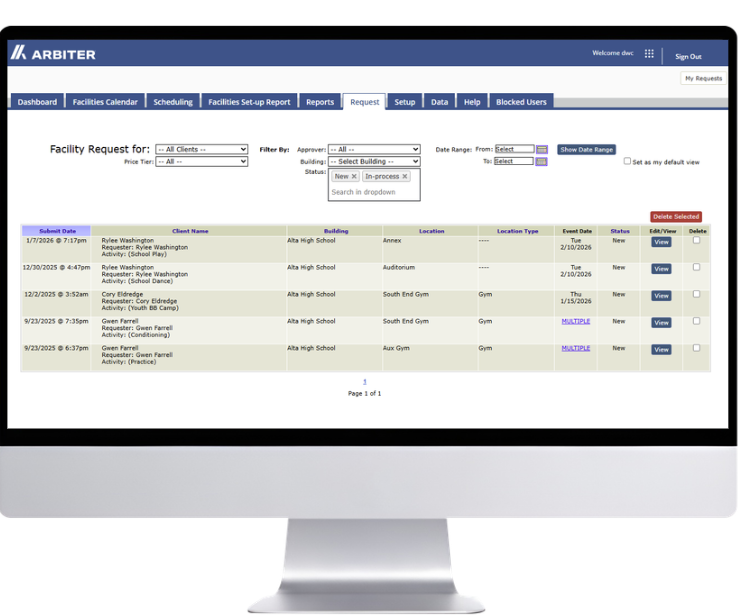
Fixing this requires more than a better calendar. It requires a clear, consistent record of how facilities are being used — for every group, every request, every approval.
This is exactly what K-12 facility scheduling software is built to handle, capturing a complete record of every request, approval, and usage detail. That means tracking:
- Who requested the space → so there’s accountability if issues come up
- When the space is being used → to prevent overlaps and unexpected use
- Who approved the request → so decisions are documented — not assumed
- What the space is being used for → so staff can prepare appropriately and avoid last-minute surprises
- Any required documentation (like insurance or agreements) → so external use is properly vetted before it happens
- What setup, equipment, or support is needed → so events don’t rely on last-minute coordination
- A record of actual usage over time → so schools can identify patterns, track wear and tear, and understand resource impact
This isn’t about adding more process. It’s about having a reliable record that reflects what’s actually happening — across every group, every building, every request.
How a Facility Booking System Changes Day-to-Day Operations
When facility use is managed in one place with facility scheduling software, the day-to-day experience shifts.
Instead of reacting to issues after they happen, teams can operate with clarity upfront.
- Availability is visible before requests are submitted
- Approvals are documented—not assumed
- Staff know what’s happening, where, and when
- Events are prepared for in advance
- Questions can be answered without chasing down information
You’re no longer checking multiple systems or following up on missing details. You’re working from a single, reliable view of what’s happening across your buildings.
That’s what turns facility scheduling from a coordination task into a controlled process.
And for most schools, that’s the difference they’re trying to create—not more process, but more clarity.
The Bottom Line
Facility scheduling software for schools isn’t just about managing time. It’s about knowing what’s happening in your buildings and being able to answer that clearly when it matters.
Without that visibility, small gaps turn into bigger risks:
- Missed approvals
- Untracked usage
- Unclear responsibility
And when questions come up, the answers aren’t always there.
A consistent system changes that.
It makes facility use visible, documented, and accountable—across every request, every group, and every building.
The next step is understanding where these gaps show up most and how schools are starting to address them.
→ See the 5 most common facility scheduling challenges schools face — and how they solve them
About the Author
Brittany taught high school English for six years. She’s passionate about helping schools simplify operations so both staff and students can thrive.