
By Brittany McLendon, Senior Content Writer
April 2026
Most schools don’t set out to build a complicated system. They adopt tools one at a time to solve immediate problems — a scheduling app here, a spreadsheet there, something for tracking physicals, something for communication.
At first, it works.
But over time, those tools stop working together.
Data gets duplicated. Updates get missed. And simple tasks start taking more time than they should.
This is usually the point where schools begin looking for athletic management software—not to add another tool, but to replace the system they’ve unintentionally built.
This shows up differently depending on your role:
– Athletic Directors feel it in day-to-day operations
– District leaders see it in a lack of visibility across schools
– Administrators deal with the compliance and reporting gaps
But the root issue is the same.
What Is Athletic Management Software for Schools?
Athletic management software for schools connects scheduling, eligibility, registration, student records, and communication into one system—so information stays accurate in real-time everywhere it’s used. It’s often referred to as sports management software for schools.
It’s designed for K–12 programs that require visibility, accountability, and compliance—not just coordination.
That’s what separates it from tools built for youth leagues or individual teams, which aren’t designed to manage institutional requirements.
If your current setup is starting to feel harder to manage, it usually shows up in a few consistent ways.
Signs Your School Has Outgrown Basic Sports Management Tools
Sign 1: Are spreadsheets and workarounds running your athletic department?
It usually doesn’t start this way.
A tracking sheet gets created to fill a gap.
Then another. Then a shared folder. Then a workaround for something the system can’t handle.
Over time, those workarounds become the system.
- Rosters live in one system
- Schedules in another
- Registration data somewhere else
Every update requires re-entry.
Every change introduces risk.
At this point, the system isn’t your tools, it’s the people holding them together.
Sign 2: Does one scheduling change trigger a chain reaction of manual work?
Reschedule a game and watch what has to happen: officials, facilities, transportation, opponents, parents, and students all need updating.
If those live in separate systems, every update is manual.
This isn’t a coordination issue—it’s a system design issue.
At the district level, it compounds fast.
One change can impact multiple schools, teams, and assignments at once.
Sign 3: Can you see what’s happening across every program in your system?
Simple questions shouldn’t be had to answer – but they are.
- Who is eligible right now?
- Who has completed registration?
- What changed after a schedule update?
When systems aren’t connected, there’s no single source of truth at the school, district and state levels.
What works for one coach doesn’t scale to a school.
What works for one school doesn’t scale to a district.
And without visibility, decisions slow down and confidence in the data drops.
Sign 4: Can you prove your eligibility records would hold up under audit?
Compliance isn’t just about having the data—it’s about being able to prove it.
That means:
- Knowing who accessed records
- Knowing what changed
- Being able to show it on demand
When eligibility lives in spreadsheets or disconnected tools, that visibility doesn’t exist.
And that’s when issues surface—during audits, disputes, or parent concerns.
Sign 5: Does your athletic department have a consistent and compliant student transfer approval process?
A compliant transfer requires:
- Eligibility verified at both schools
- Complete records transferred
- Controlled access
- A documented history of every step
Most systems don’t support that.
So what happens instead:
- Phone calls
- Forwarded emails
- Manually assembled records
No consistency.
No documentation.
No reliable way to track what actually happened.
If more than one of these feels familiar, it’s not a coincidence.
What’s Actually Causing These Problems?
The five signs above can look like separate issues.
They are not.
They’re all symptoms of the same root problem: the tools you’re using weren’t designed to work together. They weren’t designed for the full scope of what K–12 athletic administration actually requires.
Most schools build their systems over time—adding tools as new needs come up.
- A scheduling tool
- A registration platform
- A spreadsheet for tracking eligibility
- Another system for communication
Each one solves a specific problem.
But none of them are designed to operate as part of a connected system.
That’s where things start to break.
Information has to be entered multiple times.
Updates don’t carry across systems.
And the more your program grows, the harder it becomes to keep everything aligned. This is the gap that athletic management software is designed to solve.
Why This Becomes a Bigger Problem Over Time
This setup can work—for a while.
But as programs grow:
- More students
- More sports
- More staff involved
- More compliance requirements
The gaps between systems get harder to manage.
What used to be manageable becomes:
- Time-consuming
- Error-prone
- Dependent on manual coordination
At that point, the issue isn’t how your staff is working.
It’s how your system is structured.
Not All Athletic Management Software Solves This
Some platforms improve one part of the process—like scheduling or registration.
But if they don’t connect with workflows across your program, the underlying problem doesn’t go away.
You may replace one tool—but still rely on:
- Manual updates
- Duplicate data entry
- Workarounds to keep things aligned
Which means the system hasn’t really changed.
Why K–12 Athletic Programs Have Different Software Requirements Than Recreational Leagues
The issue isn’t just that your tools aren’t connected.
It’s that many of them were never built for how K–12 programs actually operate.
Recreational leagues and club teams are designed for coordination—managing schedules, rosters, and communication.
They aren’t built to:
- Control access to student records
- Maintain audit trails
- Track eligibility with accountability
- Support compliance requirements like FERPA
K–12 programs operate under different standards.
Every record matters. Every change needs to be tracked.
And every decision needs to be supported by reliable data.
That’s why tools designed for teams or leagues often fall short at the school or district level.
They weren’t built for the level of visibility, consistency, and accountability that K–12 programs require.
What the Right Solution Actually Looks Like
The goal isn’t to add another tool.
It’s to replace disconnected systems with one that works as a whole.
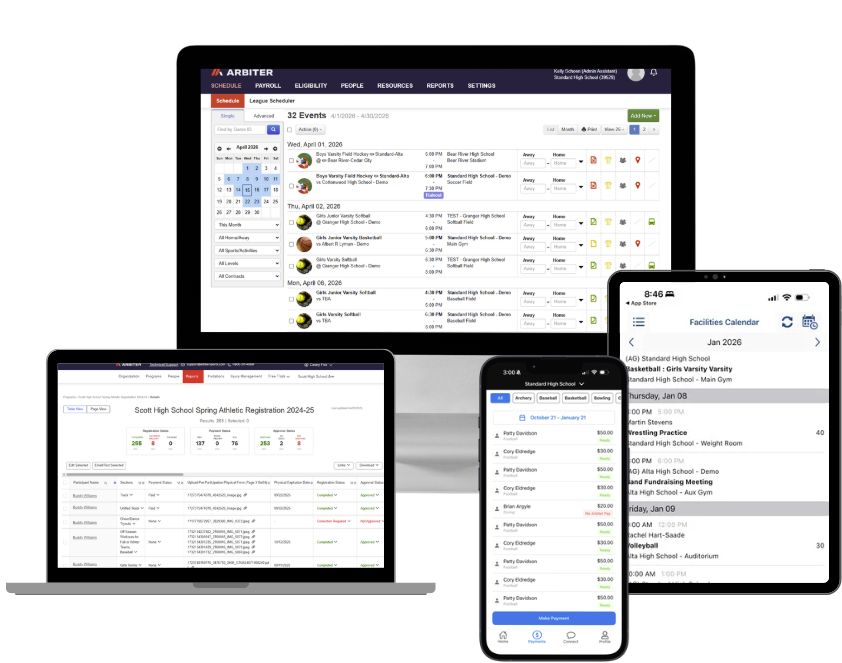
Instead of managing scheduling, registration, eligibility, and communication separately, everything operates within a connected system—so when something changes in one place, it’s reflected everywhere.
- A schedule update reflects across teams, facilities, and communications
- Eligibility status updates in real time
- Data is entered once and used everywhere it’s needed
That’s what removes the need for manual coordination.
Built for Visibility and Accountability
At the program level, staff have a clear view of what’s happening across every sport and activity.
At the district level, leaders can see consistent data across schools—without relying on manual reporting.
And at the state level, eligibility and transfer processes can be managed with transparency and consistency.
Designed for how K-12 Programs Actually Operate
Student transfers follow a structured, documented process:
- Eligibility verified at both schools
- Records transferred completely
- Access controlled by role
- Every step logged
Not a phone call.
Not a forwarded email chain.
A system.
That’s the difference.
That’s the difference between tools built to manage individual tasks—and systems built to support the full scope of K–12 athletic programs.
How to Evaluate Athletic Management Software for Your School
If you’re seeing these signs, the next step isn’t just choosing new software — it’s choosing the right category of system. Here’s what to look for:
- Does it connect your workflows — not just add features? A scheduling tool solves scheduling. A registration tool solves registration. The goal is a system where those workflows operate together—so updates carry across automatically.
- Can you enter data once and have it work everywhere it needs to? If staff still need to update multiple systems manually, the underlying problem hasn’t changed.
- Does it give you visibility across your entire program? You should be able to answer key questions—eligibility, registration status, schedule changes—without pulling data from multiple places.
- Is student data controlled, trackable, and auditable? Look for role-based access controls, audit trails, and documented compliance support — not just password protection. FERPA obligations don’t disappear because your tool doesn’t support them.
- Will your staff rely on it day-to-day? A system that requires significant workarounds to function isn’t a solution — it’s a new problem. The right solution reduces effort, not adds to it.
- Does it scale from school to district to state? What works for one team or school often breaks at scale. The system should support consistent processes across all programs.
When It’s Time to Move to Athletic Management Software
Most schools don’t make this shift all at once.
It usually becomes clear when the same issues keep showing up across your program.
You’re likely at that point if:
- More than one person is maintaining overlapping or duplicate records
- You can’t pull a compliance report without assembling it manually
- A scheduling change requires notifying people across three or more separate systems
- A student transfer requires manual coordination between schools via phone or email
- You’ve had a data error, missed eligibility flag, or compliance gap in the last year
- Your current setup depends on one person knowing where everything lives
- You have no consistent process across schools or programs in your district
When these issues become routine, it’s usually not a process problem—it’s a system limitation.
The Bottom Line
At a certain point, adding more tools doesn’t solve the problem—it adds to it.
What starts as a few helpful systems can turn into a setup that’s harder to manage, harder to trust, and harder to scale.
The challenge isn’t just keeping things organized.
It’s making sure everything works together.
Because when scheduling, registration, eligibility, and communication aren’t connected, the gaps show everywhere—in daily operations, in reporting, and when it matters most.
A connected system changes that. Athletic management software that’s truly built for K-12 changes how programs operate.
It reduces the need for manual coordination, improves visibility across your programs, and creates a more consistent way to manage your data and processes.
If you’re starting to recognize these patterns, the next step is seeing what a more connected approach looks like in practice.
Real-Time Results in a Real School
Many schools reach this point gradually—then decide to take a different approach.
At one high school in Kentucky, moving away from disconnected tools meant:
- Fewer manual updates across systems
- Clear visibility into registration and eligibility
- A more consistent process across teams and programs
It wasn’t about adding something new.
It was about replacing what wasn’t working together.

See how one athletic director gained 2 hours back a day.
About the Author
Brittany taught high school English for six years. She’s passionate about helping schools simplify operations so both staff and students can thrive.