It’s Saturday night. A fire alarm goes off in your school. First responders arrive. Someone asks: who’s in the building?
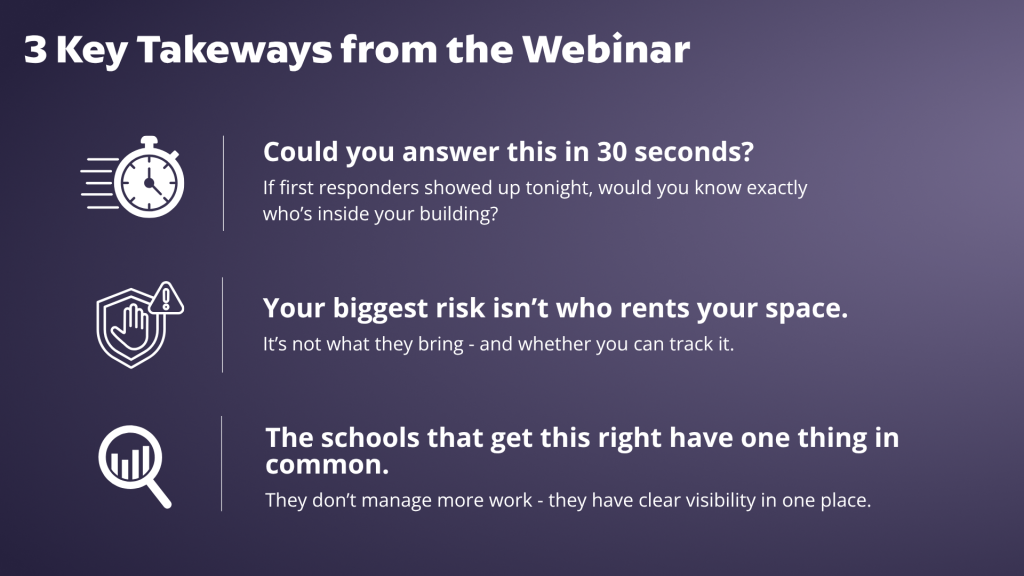
If you can’t answer that in 30 seconds, you have a facility scheduling problem.
John Kangas has spent over 20 years in school facilities—eight of them as an athletic and facilities coordinator. At Arbiter, he works with districts across the country on exactly this challenge, helping them find the gaps and close them with Arbiter Facilities Scheduler. Here’s what he sees getting missed, and what changes when districts fix it.
After Hours, Visibility Disappears
Most districts track facility use across emails, paper forms, and disconnected calendars. After hours, no one has the full picture.
After-hours access is often informal. Doors get propped open, groups move into unassigned spaces, and no one monitors entry points. Even controlled access creates problems—key cards give groups independence without accountability.
John has seen this firsthand: “I don’t know how many times I’d come in on a weekend and find a door propped open—groups inside the building, in areas they weren’t supposed to be.”
A custodian may be on-site, but without a district representative present, no one is clearly in charge. Staff hesitate to intervene. Groups assume full access. And when emergencies happen, the gaps become dangerous. John recalled reaching a group after a fire alarm went off to find them still seated inside, not ignoring it, just unclear on what to do.
You need to know who’s in your facilities and where they’re at.
— John Kangas |Former Facilities Director, TX
The Risk Isn’t Who’s There. It’s What They Bring.
The biggest liability exposures often have nothing to do with the organization using the space.
Three things show up repeatedly in after-hours incidents:
- Food vendors operating without permits or proper handling standards
- Amusement equipment dropped off by vendors who then leave—transferring liability to the school the moment they drive away
- Outside groups unclear on emergency procedures, fire codes, or what they’re actually allowed to do on campus
One example: a parent arrived at a softball game with a smoker trailer, set it up near the locker room complex, and started serving food as a team fundraiser. The fire department arrived. The event was shut down. No temporary food permit, and the equipment violated setback requirements from the building.
These situations rarely feel like safety risks until they are. The policies exist—they just aren’t being communicated or enforced at the point of booking.
There’s a reason you’re getting it cheaper. Those companies probably don’t have the right insurance or the right inspections.
— John Kangas |Former Facilities Director, TX
Your Maintenance Team Doesn’t Know Either
Facility scheduling gaps don’t just create safety risks—they create operational and financial ones too.
When outside groups use facilities without a tracked system, maintenance staff don’t know when spaces are occupied, equipment gets left out during events, and custodial workload increases without any cost recovery.
John’s district felt this directly: “My custodial department came to me and said our maintenance budget is depleted.” Once events were tracked and billed consistently, rental revenue could be redirected back to replenish supplies and replace equipment.
What Arbiter Facility Scheduler Makes Possible
When facility use runs through one system, the outcomes are immediate.
- No more scrambling after a fire alarm— you know who’s in every building, in real time, from your phone
- Insurance gaps get caught before an event, not after an incident— certificates are uploaded at booking and flagged when they expire
- Maintenance and events stop conflicting— everyone sees the same calendar, including custodial and operations teams
- First responders have access without calling you— police and fire can see what’s scheduled across your buildings at any time
- Rental revenue funds the operations it creates— trackable billing means dollars can flow back to custodial, athletics, and facilities
- For Arbiter Game users, athletic schedules sync automatically— no double entry, no outdated calendars, rainout updates included
Every district has gaps in after-hours visibility. Most don’t find out until something goes wrong.
Arbiter Facility Scheduler is built to close those gaps before that happens.
Want to See the Full Conversation?
Watch the on-demand webinar to hear John walk through every scenario in his own words – including a live platform demo.
Prefer a tailored demo? Request a demo .