The Challenge: Managing a High School Athletic Department Without the Right Tools

Casey Fisk, Athletic Director at Scott High School in Kentucky, manages 26 varsity sports programs. Two hours a day used to disappear into paperwork. Here’s what changed.
Casey Fisk didn’t become an athletic director to process paper checks at 9 p.m. on a game night.
He became one because he believes in what school sports do for students. Seven years into running the athletic department at Scott High School in Taylor Mill, Kentucky — 26 varsity programs, hundreds of events a year, more compliance requirements than he can count — Casey still leads with that same conviction. Arbiter helps him live it out in practice.
“Arbiter saves me roughly two hours a day where I can spend more time boosting our athletic programs,” Casey says. Those two hours used to go to manual payment processing, chasing down physical forms, and re-entering information across systems that didn’t talk to each other. Now they go back to students.
What Was Getting in the Way
When Casey took over the athletic department seven years ago, the tools he inherited were not built for the job. Paying officials after games meant writing physical checks on the spot — or worse, making officials wait. Student registration ran on paper forms that had to be collected, scanned, and manually filed. Compliance reports for the Kentucky High School Athletic Association (KHSAA) required pulling data from multiple places and entering it again somewhere else.
The list never ends. Managing the athletic department, balancing budgets, handling game day operations, hiring coaches, promoting teams, scheduling — plus all the paperwork and legal requirements.
The manual payment problem was the most acute. When officials changed assignments at the last minute, there was no good answer. “You couldn’t create a purchase order, write a check, and handle all that on the fly,” Casey recalls. Someone always had to wait. Someone always had to follow up.
It wasn’t a technology problem, exactly. It was a fragmentation problem — too many disconnected systems, each solving one small piece of a much larger operational puzzle.
The Solution: Harnessing the Power of Arbiter

Casey didn’t overhaul everything at once. He built toward a connected system product by product, starting with the pain point that was costing him the most time. His journey with Arbiter began in 2018 with Arbiter Pay, expanding to include Registration in 2019, and most recently, being a champion advocate for the KHSAA’s adoption of Arbiter 360 at the state level.
Arbiter Pay: Pay officials before they leave the building
Casey adopted Arbiter Pay in 2018 after hearing about it from peers. The appeal was immediate and practical: instead of processing paper checks after every game, he could pay officials electronically — on the spot, from his phone.
As soon as I heard about Arbiter Pay, I started using it to save time. My officials appreciate that I pay them right away as soon as I see them, whereas other schools might wait a week or so.
That shift alone changed the dynamic at Scott High School. Officials notice when they’re paid promptly and accurately. Casey’s reputation for running a professional, reliable operation is built, in part, on a payment workflow that takes seconds instead of days.
Arbiter Registration: No more chasing paperwork before the first game
In 2019, Casey added Arbiter Registration — a move that turned out to be well-timed in ways he didn’t anticipate.
We were able to be so far ahead of the game when COVID hit. We could keep and store information digitally without having to physically touch or interact — it made life so much easier.
Coaches noticed immediately. “Coaches love that they don’t have to collect paperwork,” Casey explains. Students and families submit forms, physicals, and payments through one digital workflow. Casey and his staff have a single source of truth for who’s eligible, who’s cleared, and who still needs to submit something. No more chasing down missing signatures on game day.
Arbiter 360: State-Level Integration
When the Kentucky High School Athletic Association (KHSAA) transitioned to a statewide platform, Scott High School was already positioned to connect. The Arbiter 360, integration allows clean, accurate data to flow from Casey’s day-to-day operations directly to state-level reporting — eliminating a second round of data entry for Title IX compliance, student transfers, and other KHSAA requirements.
It’s one less place for errors to creep in. One fewer system to maintain. That matters when you’re managing 26 sports programs and the stakes on compliance are real.
What a Day Looks Like Now
Casey’s morning used to start with a list of follow-ups. Who didn’t get paid last night. Which form was still missing. Which schedule update hadn’t been communicated yet.
Now it starts from one place.
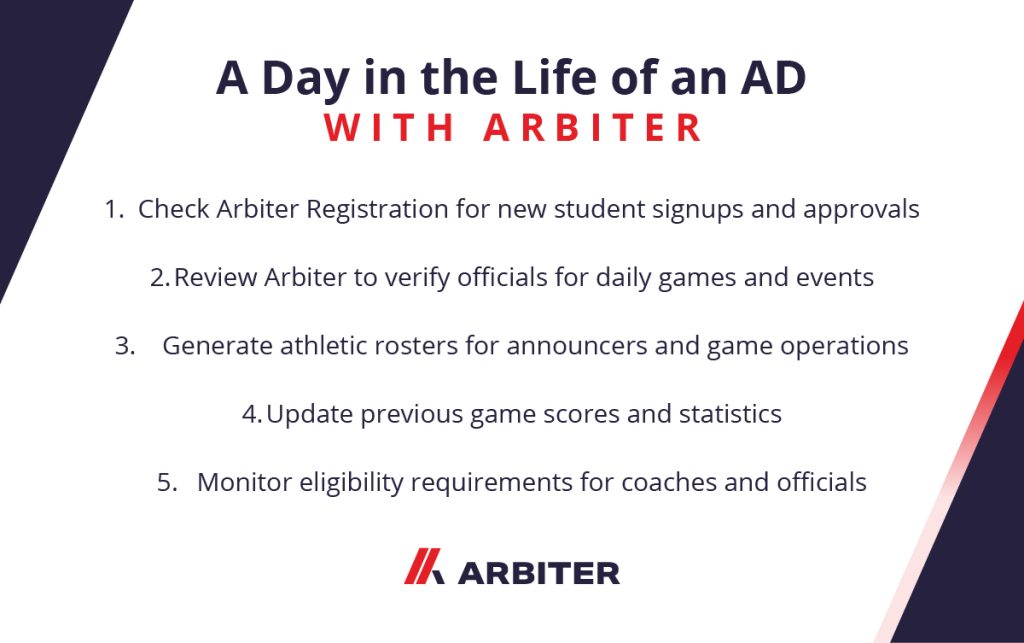
I can manage everything, and I mean everything, in the athletic department from one place,” Casey emphasizes. “I can contact any athletic director in the state, any coach, any principal. I can pull up addresses for other schools. It’s a one-stop shop.
That consolidation — one platform instead of four or five disconnected tools — is where the 2 hours a day come from. Not from any single feature, but from eliminating the overhead of switching between systems, re-entering data, and manually connecting dots that a connected platform connects automatically.
“I know everything is going to be accurate and correct, ” Casey explained. For an athletic director managing compliance requirements, payment records, and student eligibility simultaneously, that confidence is not a small thing.
The Overall Impact of Arbiter
2 Hours Saved Daily
“Arbiter saves me roughly two hours a day where I can spend more time boosting our athletic programs,” Casey reports. This time savings translates directly to increased focus on student-athlete development and program enhancement.
Enhanced Accuracy and Reliability
“I know that everything is going to be accurate and correct,” Casey notes, highlighting the confidence Arbiter provides in critical administrative functions.
Streamlined Coach Experience
“Coaches love that they don’t have to collect paperwork,” Casey explains. The platform enables coaches to focus on coaching while maintaining necessary administrative oversight.
Cost Savings
The integrated platform eliminates the need for multiple disparate systems, providing significant cost savings that can be redirected to athletic programs.
The Recommendation: A Welcomed Change
“As much as I hate change, this has been a welcomed change. Extremely smooth,” Casey reflects. His enthusiasm extends beyond personal experience to industry advocacy:
“I would be more than willing to talk to other states and athletic departments just to show them how beneficial it has been for us.”
For athletic directors considering comprehensive management solutions, Casey’s advice is clear: “It makes your life so much easier.”
About Scott High School Athletics
- Location: Taylor Mill, Kentucky
- Sports Programs: 26 varsity sports
- Arbiter Products Used: Arbiter Pay, Arbiter Registration, Arbiter 360
- Partnership Timeline: 2018-2025
- Key Stakeholders: Athletic directors, coaches, officials, student-athletes, parents, community
Transform Your School With Arbiter
Ready to transform your athletic administration like Casey? Discover how Arbiter’s comprehensive platform can save you time, reduce costs, and enhance your focus on student-athlete development. Click here to learn more.
FAQs
What is Arbiter 360?
Arbiter 360 is a statewide management system used by athletic associations to oversee eligibility, transfers, compliance, and tournament operations across all member schools.
Who uses Arbiter 360?
Arbiter 360 is designed for Executive Directors, compliance and eligibility administrators, and association staff who coordinate policies, approvals, and postseason activities at the state level.
What functions does Arbiter 360 provide?
- Statewide eligibility management
- Electronic transfer workflows
- Tournament scheduling and advancement tracking
- Compliance and participation reporting
- Secure communication between schools and the state office
FAQs
What is Arbiter Pay?
Arbiter Pay is a K-12 payments platform that schools use to pay officials, event staff, and other 1099 workers quickly and securely. It eliminates paper checks and cash handling and provides 1099 records and compliance reporting.
Who uses Arbiter Pay?
Arbiter Pay is built for athletic directors, business offices, and finance teams that need a centralized, compliant way to pay 1099 workers. Officials, referees, and event staff benefit from faster, more reliable payments.
How does Arbiter Pay help schools save time?
Arbiter Pay school payment system saves hours each week by replacing paper checks and manual reporting. Finance staff avoid duplicate entry, and ADs no longer track down unpaid officials. Lubbock-Cooper ISD saved $7,000 annually with Arbiter Pay.