By Brittany McLendon, Senior Content Writer
When a student gets benched because of an eligibility error no one caught, it’s more than frustrating—it’s disruptive to your athletes, your coaches, and your entire athletic program. But eligibility failures don’t happen because someone made a careless mistake.
They happen because hidden data-integrity problems lurk in the gaps between your student information system (SIS), registration workflows, and compliance records. This article breaks down the eight most common culprits—and gives you a clear diagnostic checklist for catching them early.
What causes eligibility tracking failures in K-12 schools?
Eligibility tracking failures typically stem from data-integrity breakdowns at key handoff points: when student records sync from your SIS, when enrollment eligibility rules get updated, or when registration workflows change mid-season.
Every step that requires human intervention instead of automated validation is a place where errors accumulate quietly until someone is standing on the sideline who shouldn’t be. Each failure has warning signs if you know where to look.
1. SIS sync mismatches that create ghost records
Your SIS is the single source of truth for student demographics, enrollment status, and academic standing. But when data doesn’t sync correctly, you end up with ghost records—students who appear eligible in one system but ineligible in another.
Warning signs to watch
- Student names or IDs appear differently across systems
- Enrollment dates don’t match between your SIS and registration platform
- Transfer students show conflicting residency data
How to catch it early
Run a weekly reconciliation report comparing your SIS roster against your eligibility dashboard. Arbiter connects directly to your existing data sources, so discrepancies surface immediately rather than hiding until game day.
2. Enrollment eligibility rules applied inconsistently
State athletic associations set specific enrollment eligibility rules—days enrolled, transfer windows, academic thresholds. When these rules get applied inconsistently across sports or seasons, students slip through the cracks.
Warning signs to watch
- Different coaches interpret eligibility cutoffs differently
- Manual overrides happen without documentation
- New staff aren’t trained on current eligibility policies
How to catch it early
Standardize your eligibility rules in a single platform with automated checks. Arbiter centralizes eligibility tracking so your entire athletic department follows the same criteria, every time.
3. Registration workflow errors that skip required steps
When families register students for athletics, missing a single form—a physical, a consent waiver, an emergency contact card—can trigger ineligibility. Registration workflow errors happen when your system lets incomplete registrations proceed anyway.
Warning signs to watch
- Students appear on rosters with “pending” status that never resolves
- Coaches report athletes missing required documents after tryouts
- Last-minute scrambles to collect forms before games
How to catch it early
Configure your registration system to require all fields before submission. Arbiter makes registration straightforward for families and requires 100% complete registrations before approval—no partial submissions allowed.
4. Academic grade data that arrives late or incomplete
Academic eligibility depends on grades, but grade data often flows from a separate gradebook system. When that data arrives late, students may be cleared to play when they shouldn’t be—or held out when they’re actually eligible.
Warning signs to watch
- Grade updates lag behind marking period deadlines
- Manual grade entry leads to transcription errors
- Teachers use different grading scales that don’t map consistently
How to catch it early
Establish clear deadlines for grade submission and automate the data pull. When automation isn’t available, build a manual verification step with a documented timestamp so you know exactly when grade data was last confirmed.
5. Untracked configuration and policy changes
Mid-year policy changes—a new transfer rule, updated academic thresholds, revised age cutoffs—can invalidate previously cleared students. If those changes aren’t logged and communicated, your eligibility data becomes outdated instantly.
Warning signs to watch
- State association sends rule updates, but no one updates your system
- Configuration changes happen without audit trails
- Staff disagree on which version of a rule applies
How to catch it early
Maintain a change log for every eligibility rule modification. Arbiter gives you real-time compliance dashboards so your athletic department always sees the current status—not last month’s snapshot.
6. Transfer student records with missing verification
Transfer students require extra eligibility verification: previous school records, athletic participation history, residency documentation. When verification steps get skipped, ineligible transfers can slip onto your roster.
Warning signs to watch
- Transfer files sit in email inboxes instead of your registration system
- Previous school coaches are unreachable during clearance windows
- Residency documents submitted without review
How to catch it early
Create a dedicated transfer verification workflow with mandatory checkpoints. The National Federation of State High School Associations (NFHS) recommends establishing clear protocols for transfer eligibility to ensure consistent rule enforcement across schools.
7. Medical clearance data stored in disconnected locations
Physical exams, concussion protocols, and medical waivers are critical eligibility components. When this data lives in a nurse’s office filing cabinet instead of your registration system, it’s easy for an athlete to be cleared without proper medical documentation.
Warning signs to watch
- Coaches can’t verify whether a physical is current
- Concussion return-to-play protocols aren’t tracked electronically
- Medical forms expire without alerts
How to catch it early
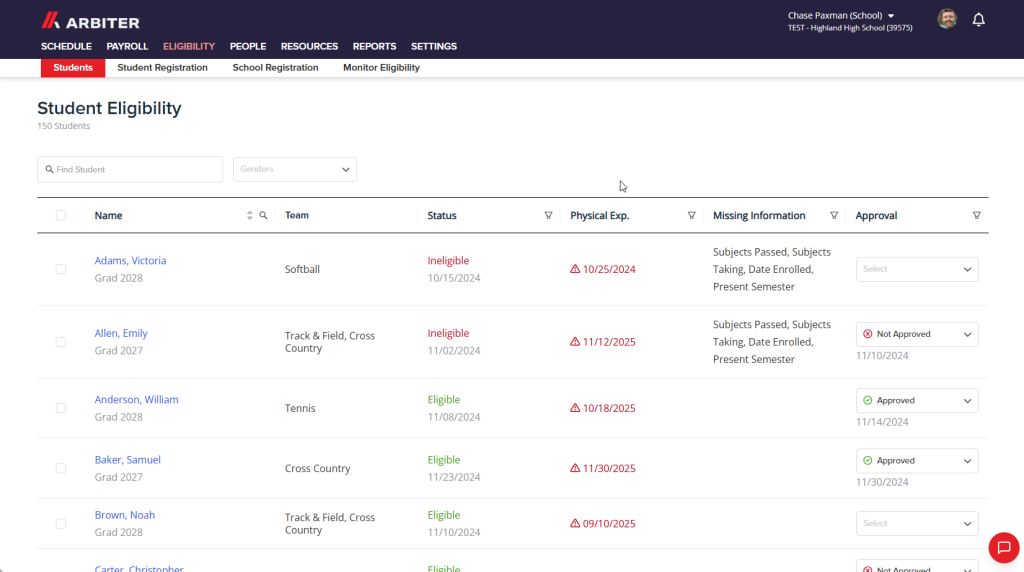
Digitize all medical clearance documentation in a single platform. Arbiter stores rosters, medical forms, and emergency contacts in one secure location—giving coaches and athletic directors instant access when they need it.
8. Role-based permission gaps that allow unauthorized changes
When too many people can edit eligibility records—or when the wrong people have access—you risk unauthorized changes that compromise data integrity. A coach marking a student “eligible” to fill a roster spot creates a compliance liability.
Warning signs to watch
- Multiple staff have admin-level access without clear roles
- Eligibility overrides happen without approval workflows
- No audit trail shows who changed what and when
How to catch it early
Implement role-based access controls that match your organizational structure. Arbiter offers secure, role-based access for staff and volunteers—so only authorized personnel can approve eligibility changes.
How to Audit Your Current Eligibility Tracking Process
Start by mapping every point where student data moves between systems. Then ask:
- Does your SIS data sync automatically, or does someone have to initiate it?
- Who has permission to override eligibility status, and is that logged?
- How quickly does your team learn about state rule changes — and how do those changes get into your system?
- Where do medical clearance documents actually live?
- Can you generate a full compliance report in under five minutes?
If any of those questions don’t have a confident answer, you have a visibility gap.
→ Want a faster way to assess the full picture?

The Student Registration Health Check is a 10-question audit that reveals the most common gaps in registration and eligibility workflows — with a scored result that tells you where your process stands.
See Where Eligibility Breakdowns Start Before They Become Compliance Problems
Disconnected systems, manual workflows, and inconsistent rule enforcement don’t announce themselves. They accumulate quietly until something goes wrong on the field — or in a compliance review.
Arbiter gives athletic directors full visibility across registration, eligibility, and compliance in one platform. Schools using Arbiter get real-time dashboards, automated requirement enforcement, role-based access controls, and live support from people who understand how K-12 athletics actually operates.
Explore Eligibility workflows in Arbiter →
FAQs About Eligibility Tracking Failures in K-12
What is the most common cause of eligibility tracking failures in K-12 schools?
SIS sync mismatches are the most common root cause. When student data doesn’t transfer correctly between your SIS and your eligibility platform, records conflict and students get flagged — or cleared — incorrectly. Automated reconciliation between systems catches discrepancies before they affect game-day rosters.
How often should schools audit their eligibility records?
At minimum, weekly during active sports seasons. Running reconciliation reports between your SIS and eligibility dashboard during the season helps you catch errors before they affect rosters. During the offseason, a monthly audit is sufficient to catch rule changes and system configuration issues before the next season starts.
What systems should integrate with eligibility tracking?
At minimum: your SIS, registration platform, gradebook, and medical records. Ideally, scheduling and payment systems integrate as well — so eligibility status is visible in the same place where rosters are built and participation fees are collected. The more handoffs that happen outside a connected system, the more exposure you have.
Why do eligibility errors increase during staff turnover?
Because eligibility workflows that rely on institutional knowledge — rather than system-enforced processes — break down when the person who held that knowledge leaves. Documented workflows, role-based permissions, and audit trails are what protect continuity across staff transitions.
What happens when eligibility tracking relies on spreadsheets?
Spreadsheets have no enforcement capability, no audit trail, no version control, and no alerts. A spreadsheet can tell you what the eligibility status was when someone last updated it. It can’t tell you whether that information is still accurate, who changed it, or whether a rule update has made it obsolete.
Can registration errors affect student eligibility?
Yes. Missing forms — physicals, signed waivers, emergency contacts — are eligibility requirements, not optional paperwork. Registration systems that allow incomplete submissions to proceed create downstream eligibility exposure when those gaps surface at the worst possible time.
How do transfer students create eligibility complications?
Transfer students require verification of previous school records, athletic participation history, and residency documentation — often on tight timelines and with external parties who may be slow to respond. Without a mandatory-checkpoint workflow, verification steps get skipped and ineligible transfers appear on rosters.
About the Author
Brittany taught high school English for six years. She’s passionate about helping schools simplify operations so both staff and students can thrive.